

CMP and CBC are the two most commonly ordered blood panels, but they measure completely different things. Many people assume they are interchangeable or wonder why a doctor orders both. A CBC, or complete blood count, evaluates your blood cells. A CMP, or comprehensive metabolic panel, evaluates blood chemistry, organ function, and metabolic balance. Together, they provide a broader health snapshot than either test alone. You can also review this guide to routine blood panels for an overview of common lab tests.
What a CBC Measures
A CBC measures the cells and cell-related components circulating in your blood. It typically includes:
Red blood cells (RBCs): Carry oxygen throughout the body.
White blood cells (WBCs): Help defend against infection and inflammation.
White blood cell differential: Breaks white blood cells into types, including neutrophils, lymphocytes, monocytes, eosinophils, and basophils.
Platelets: Help blood clot after an injury.
Hemoglobin: The oxygen-carrying protein inside red blood cells.
Hematocrit: The percentage of blood made up of red blood cells.
Abnormal CBC results may provide clues about infection, anemia, inflammation, clotting problems, or blood disorders. Results should be interpreted alongside your symptoms, medical history, and the laboratory’s reference ranges.
For a marker-by-marker explanation, see this guide to understanding CBC results.

What a CMP Measures
A CMP measures 14 substances related to blood sugar, electrolytes, kidney function, liver function, and proteins. The panel includes:
Glucose: Blood sugar.
Calcium: Supports bones, muscles, nerves, and heart function.
Sodium: Helps regulate fluid balance and nerve signaling.
Potassium: Supports muscle and heart function.
Chloride: Helps maintain fluid and acid-base balance.
CO2 or bicarbonate: Provides information about acid-base balance.
BUN: A waste product used to help assess kidney function.
Creatinine: Another kidney function marker.
ALT: A liver enzyme that can rise with liver cell injury.
AST: An enzyme associated with the liver and other tissues.
ALP: An enzyme related to the liver, bile ducts, and bones.
Bilirubin: A waste product processed by the liver.
Albumin: A major blood protein made by the liver.
Total protein: The combined amount of major proteins in the blood.
A CMP can help identify patterns associated with diabetes or abnormal blood sugar, kidney problems, liver conditions, electrolyte imbalance, and changes in protein levels. It does not diagnose every condition by itself. Your clinician may order follow-up testing when a result is outside the expected range.
Read the complete CMP test overview for more detail about what each marker can show.
CBC vs CMP: Side-by-Side
Test | What It Measures | What It Detects or Helps Assess | Typical Use |
|---|---|---|---|
CBC | Red blood cells, white blood cells, differential, platelets, hemoglobin, and hematocrit | Infection, anemia, inflammation, clotting issues, and blood disorders | Routine health checks, fatigue, fever, bruising, bleeding, or monitoring blood-related conditions |
CMP | Glucose, calcium, electrolytes, BUN, creatinine, liver enzymes, bilirubin, albumin, and total protein | Blood sugar, kidney function, liver function, electrolyte balance, and protein status | Routine health checks, medication monitoring, dehydration, abdominal symptoms, or metabolic concerns |
A CBC and CMP answer different clinical questions. Neither test is universally better; the appropriate panel depends on what your clinician is evaluating.
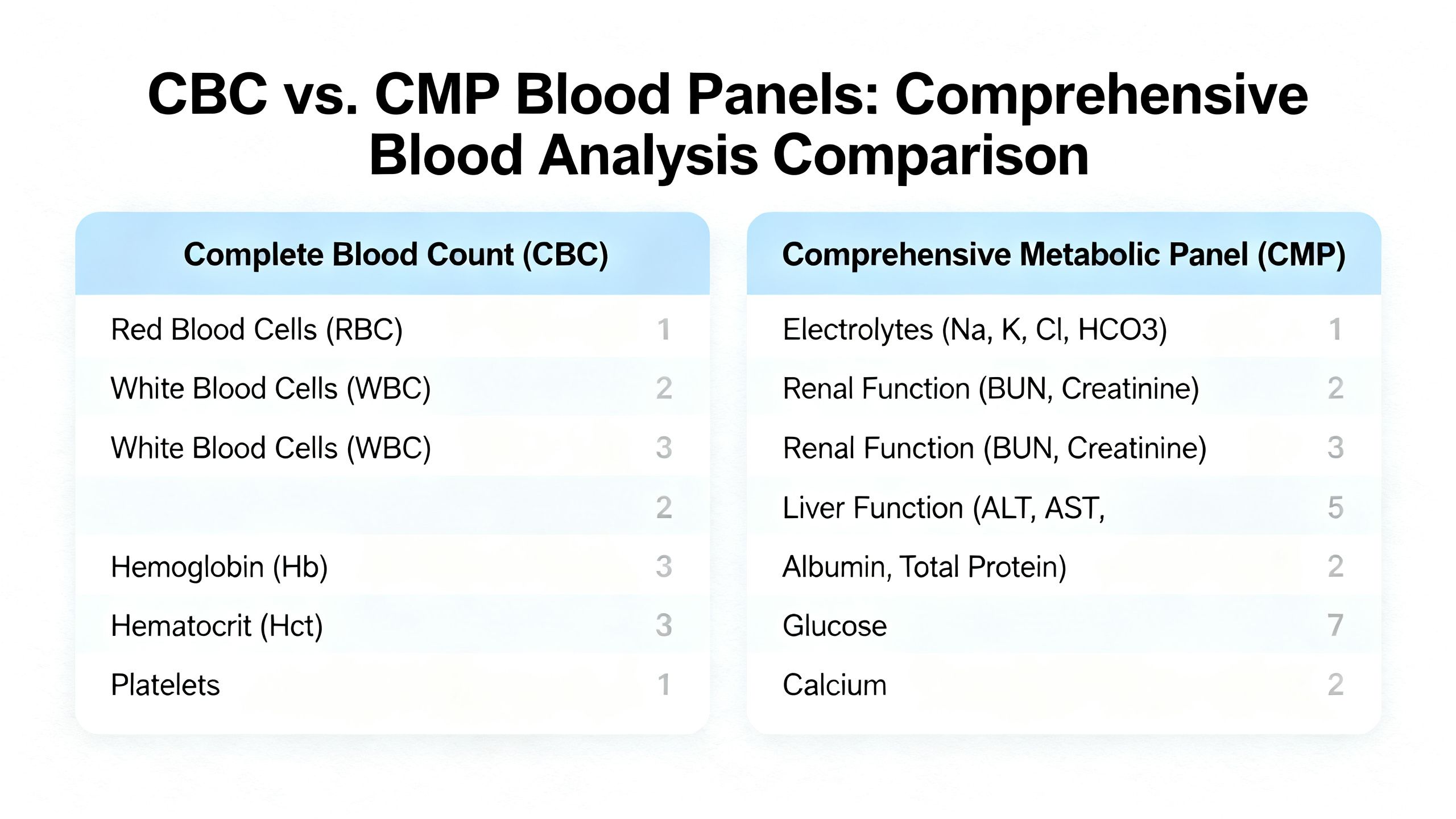
Why Doctors Often Order Both Together
During a routine physical, ordering both panels gives complementary information. The CBC looks at the blood’s cellular components, while the CMP examines chemical balance and markers associated with the kidneys, liver, blood sugar, and electrolytes.
Together, they may help establish a baseline, investigate nonspecific symptoms, or monitor an existing condition or medication. Still, results need context: an isolated abnormal value does not necessarily mean you have a disease.
CMP vs BMP: Quick Clarification
A BMP, or basic metabolic panel, is a smaller panel that generally includes eight markers: glucose, calcium, sodium, potassium, chloride, CO2 or bicarbonate, BUN, and creatinine. Unlike a CMP, it does not include the liver and protein markers such as ALT, AST, ALP, bilirubin, albumin, and total protein.
The Basic Metabolic Panel comparison explains how a BMP differs from a CMP and when each may be used.
Which One Do You Need?
The answer depends on the reason for testing:
Routine checkup: A CBC, CMP, or both may be used to establish a general health baseline.
Fatigue, weakness, or pallor: A CBC may help evaluate anemia or other blood-related causes. A CMP may also be useful when metabolic or organ-related causes are being considered.
Fever or suspected infection: A CBC can provide information about white blood cells. Additional testing may be needed to identify the cause.
Medication or chronic-condition monitoring: A CMP may be used to monitor kidney function, liver enzymes, electrolytes, or glucose. A CBC may be needed if a medication or condition affects blood cells.
Bruising or unusual bleeding: A CBC, particularly the platelet count, may be relevant, although further testing may be necessary.
Known kidney, liver, or metabolic concerns: A CMP is often more directly relevant than a CBC, but your clinician may order both.
In San Antonio, TX, Direct Care Labs offers a CMP for $25 and a CBC for $20, with results in 1–2 business days. No physician order or insurance is needed through the service. You can learn more about available general health tests in San Antonio.
Texas law permits consumers to order their own lab testing through certified providers. If you order testing directly, share the results with your healthcare professional rather than interpreting them in isolation.
Frequently Asked Questions
Can I get just a CBC or just a CMP instead of both?
Yes. A CBC and CMP are separate panels, so one may be appropriate depending on your symptoms, health history, or monitoring needs. They are often ordered together when a broader assessment is useful, but one is not automatically required with the other.
Do I need to fast for a CBC or CMP?
A CBC usually does not require fasting. A CMP may or may not require fasting, depending on why it was ordered and whether glucose or other tests are being evaluated alongside it. Follow the instructions from your clinician or testing provider. If you take medications or supplements, ask whether you should take them before the blood draw.
How much do the CBC and CMP cost separately?
At Direct Care Labs in San Antonio, TX, the CBC is $20 and the CMP is $25 when ordered separately, for a combined total of $45. Prices and availability can change, so confirm current details before testing. Insurance is not required.
How often should I get a CBC or CMP?
There is no single schedule for everyone. Testing frequency depends on age, symptoms, medications, chronic conditions, previous results, and your clinician’s recommendations. Some people have these panels during an annual checkup, while others need more frequent monitoring.
Is it legal to order a CBC or CMP myself in Texas?
Yes. Texas law permits consumers to order their own lab testing through certified providers. Direct-to-consumer testing does not replace a medical evaluation, and an abnormal result may require repeat testing or follow-up with a physician.
Can a CBC or CMP diagnose a condition by itself?
Usually not. These panels provide measurements and patterns that can support a diagnosis, but symptoms, examination findings, medical history, and sometimes additional tests are also needed. Discuss your results with your doctor; these tests are not a substitute for medical advice.