

ApoB is now considered a stronger predictor of heart attack risk than LDL cholesterol alone. About 15–20% of people have elevated ApoB despite a normal LDL result, so a standard cholesterol panel can miss meaningful cardiovascular risk. The cholesterol panel blood test remains useful, but ApoB can add a clearer view of the particles that contribute to plaque formation.
What ApoB Actually Measures
Apolipoprotein B, usually called ApoB, is a protein found on atherogenic lipoprotein particles. Each LDL, VLDL, IDL, and Lp(a) particle carries exactly one ApoB molecule.
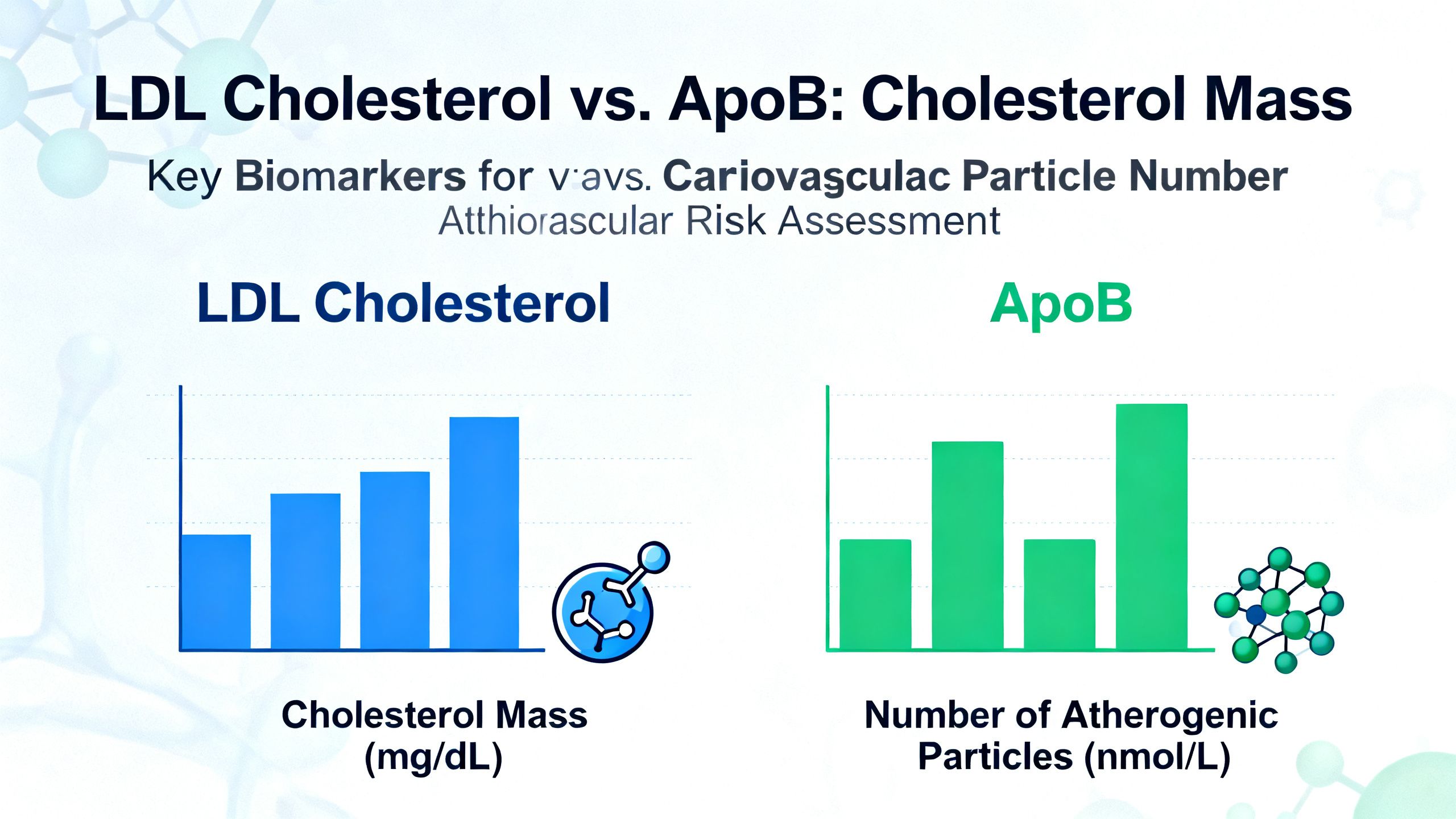
That makes ApoB a practical particle count. LDL cholesterol, by contrast, measures the amount of cholesterol contained inside LDL particles—the cholesterol mass.
A simple analogy: LDL cholesterol tells you how much cargo is being transported, while ApoB estimates how many delivery vehicles are on the road. More vehicles can mean more opportunities for particles to enter artery walls, even when the total cholesterol cargo looks acceptable.
ApoB testing also complements an Lp(a) blood test, since Lp(a) is an ApoB-containing particle with largely genetic effects on cardiovascular risk.

Why ApoB Predicts Risk Better Than LDL
Atherosclerosis is driven in part by the number of atherogenic particles that enter and remain in artery walls. Because each of these particles carries one ApoB molecule, ApoB provides an estimate of particle number rather than relying only on the amount of cholesterol inside those particles.
This explains ApoB-LDL discordance. Someone may have normal LDL cholesterol but elevated ApoB because their LDL particles contain less cholesterol than average or because other ApoB-containing particles contribute to the total. In this situation, LDL may look reassuring while particle exposure remains higher.
About 15–20% of people have this type of elevated ApoB with normal LDL. The 2026 AHA/ACC guidance incorporates ApoB targets alongside LDL in cardiovascular risk assessment and treatment decisions. ApoB is not a replacement for clinical evaluation, but it can provide information that LDL alone does not show.
Normal vs Target ApoB Levels
ApoB ranges are not universal. Your laboratory’s reference interval describes how results are reported, while a cardiology target reflects your overall cardiovascular risk, medical history, and treatment plan.
Category | ApoB level | How to interpret it |
|---|---|---|
Typical laboratory reference range | Under 100–130 mg/dL, depending on the lab | May be reported as within the laboratory range; this is not necessarily an optimal treatment target |
Common cardiology target for average risk | Under 80 mg/dL | A more prevention-focused goal used by some clinicians |
Common target for high-risk patients on statin therapy | Under 65 mg/dL | May be considered when cardiovascular risk is high, based on the clinician’s treatment plan |
A result should be interpreted alongside age, blood pressure, diabetes status, smoking history, family history, LDL, Lp(a), triglycerides, and prior cardiovascular disease. The Direct Care Labs cholesterol test can be used with ApoB to evaluate these related lipid markers.
Who Should Get Tested
Family history or a discordant lipid panel
ApoB may be useful if a parent or sibling had premature heart disease, or if your LDL and triglyceride results do not seem to match your broader risk profile. It can also help clarify risk when triglycerides are elevated, metabolic health is a concern, or LDL appears normal despite a strong family history.
People with elevated Lp(a), diabetes, insulin resistance, or a history of cardiovascular disease may also discuss ApoB with their clinician. If you are in San Antonio, Texas, Direct Care Labs offers ApoB testing for $35, with no physician order or insurance needed. Texas law permits consumers to order their own lab testing through certified providers like Direct Care Labs.
Already on statin therapy
If you take statins or another lipid-lowering medication, ApoB can help track the number of atherogenic particles remaining after treatment. This may be useful when LDL improves but triglycerides, metabolic risk, or other markers remain concerning.
ApoB should be measured consistently when monitoring treatment, and medication changes should be guided by your doctor. For additional information about arranging testing without a referral, see this guide to blood work without a doctor’s referral in San Antonio.
What Affects Your ApoB
Several factors can raise or lower ApoB:
Genetics: Inherited lipid disorders and family patterns can elevate ApoB even with a generally healthy lifestyle.
Diet: Diets high in saturated fat or excess refined carbohydrates may worsen LDL-containing particles or triglyceride-rich particles in some people.
Insulin resistance: Higher blood sugar and insulin resistance can increase triglyceride-rich lipoproteins and contribute to ApoB elevation.
Thyroid function: Underactive thyroid function can affect cholesterol metabolism and may raise atherogenic lipoproteins.
Body composition and activity: Excess body fat, low physical activity, and metabolic syndrome can influence ApoB-related particles.
Medications and health conditions: Kidney disease, liver conditions, and certain medications can affect lipid results.
ApoB is one part of preventive testing. A broader annual health check-up may help evaluate related blood, metabolic, and organ-function markers.

How to Lower ApoB
Lifestyle changes are often the first step, especially when ApoB is mildly or moderately elevated:
Emphasize vegetables, fruit, legumes, whole grains, nuts, fish, and minimally processed foods.
Replace foods high in saturated fat with sources of unsaturated fat when appropriate.
Limit excess refined carbohydrates and added sugars, particularly when triglycerides or insulin resistance are elevated.
Exercise regularly with a combination of aerobic activity and resistance training.
Reach and maintain a healthy weight if recommended for your health.
Avoid tobacco and address blood pressure, blood sugar, and sleep-related health issues.
When lifestyle measures are not enough—or when cardiovascular risk is high—a clinician may recommend medication. Statins are commonly used to lower atherogenic cholesterol and particle exposure. Depending on risk and response, treatment may also include other medications, such as PCSK9 inhibitors.
Direct Care Labs in San Antonio offers ApoB testing for $35, with results typically available in 1–2 business days. Testing can show where your ApoB stands, but treatment targets should be selected with a healthcare professional. You can also review Direct Care Labs’ Lp(a) testing option if inherited cardiovascular risk is a concern.
Frequently Asked Questions
Is ApoB the same as LDL?
No. LDL cholesterol measures the cholesterol mass inside LDL particles. ApoB estimates the total number of atherogenic particles, including LDL, VLDL, IDL, and Lp(a). The results are related but can be discordant.
Do I need to fast for an ApoB test?
Fasting is not always required for ApoB alone. However, your clinician or laboratory may recommend fasting if ApoB is being measured with triglycerides and a complete lipid panel, or if previous results were difficult to interpret. Follow the preparation instructions provided with your order.
How often should I retest ApoB?
Retesting depends on your risk profile and whether you have started or changed treatment. A clinician may repeat the test after a medication or major lifestyle change has had time to affect your levels, or periodically as part of cardiovascular risk monitoring.
What is considered a high ApoB level?
There is no single cutoff that applies to everyone. Laboratory reference ranges are commonly under 100–130 mg/dL, depending on the lab. Many cardiology targets are lower, including under 80 mg/dL for average-risk prevention and under 65 mg/dL for some high-risk patients receiving statin therapy.
Is it legal to order ApoB testing myself in Texas?
Yes. Texas law permits consumers to order their own lab testing through certified providers such as Direct Care Labs. In San Antonio, Direct Care Labs offers ApoB testing for $35 without a physician order or insurance, with results in 1–2 business days. Consider discussing the result and next steps with your doctor.
What should I do if my ApoB is elevated but my LDL is normal?
Do not interpret the two numbers separately. Review ApoB with LDL, triglycerides, Lp(a), blood pressure, blood sugar, family history, and other risk factors. This information is not a substitute for medical advice; discuss your results and targets with your doctor.